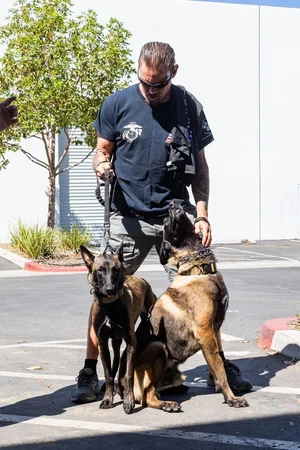
I've spent decades training and teaching martial arts. I've also spent decades working in environments where violence wasn't theoretical—nightclubs, rock concerts, private events, personal protection, and, more recently, hospital security.
Those experiences have shaped the way I look at self-defense.
And one lesson keeps coming back:
The failed technique isn't free.
There Is No Reset Button
Martial arts demonstrations can make almost anything look effective.
The attacker knows what attack to perform. The defender knows what's coming. Speed and resistance are controlled. Both people know how the technique is supposed to end.
If something goes wrong, you reset and try again.
Real violence doesn't give you that luxury.
I've dealt with violent people in crowded nightclubs, worked security at major rock concerts, provided personal protection, and dealt with aggressive and combative people in an emergency department.
The environments change. The underlying problem doesn't:
The other person isn't cooperating with your technique.
If your first response fails, the punch may land. You may lose your balance. You may get grabbed or driven backward. There may be another attack immediately behind the first.
Failure has consequences.
Violence Doesn't Follow the Lesson Plan
Choreographed self-defense has value. We need predictable attacks and responses when initially learning mechanics.
The problem comes when we begin expecting an actual confrontation to follow the choreography.
Real people don't attack like training partners. They stumble. They charge. They grab unexpectedly. They miss. They throw ugly punches. They keep attacking.
The environment won't cooperate either. A nightclub may be crowded and slippery. A concert has bodies everywhere. Personal protection puts other people into the equation. A hospital room may have beds, walls and equipment restricting movement.
There is no guaranteed distance, position, or attack.
Effective Doesn't Always Look Pretty
Years of security work have also taught me something about optics.
A fast, decisive control may appear aggressive to someone watching from across the room or seeing a few seconds of video without context. Meanwhile, a technique that looks controlled and sophisticated during a demonstration may accomplish very little against someone who is genuinely resisting.
The question shouldn't simply be:
“Did that look good?”
It should be:
“Was it appropriate, and did it work?”
Appropriate matters. Self-defense isn't an excuse for unnecessary force.
But ineffective restraint isn't necessarily safer restraint. Sometimes establishing control quickly prevents a prolonged struggle and actually reduces the total amount of force required.
We shouldn't confuse what looks better with what produces the safer outcome.
Principles Matter More Than Choreography
This is fundamental to how I approach MISD.
We practice specific attacks and responses because students need structure. But the technique is ultimately a way of learning principles:
Distance. Position. Angles. Balance. Leverage. Targets. Movement. Recovery. Control.
Those principles remain useful when the situation changes.
Maybe your strike misses. Maybe the attacker moves. Maybe your attempted control fails. Maybe another attack is coming.
You have to recognize what changed and adapt.
The confrontation doesn't know the combination you practiced.
That's also why training eventually has to progress beyond cooperation. Learn the mechanics first. Develop control. Increase speed. Add movement, resistance, and unpredictability.
As proficiency improves, cooperation should decrease.
After decades in martial arts and real-world security work, I'm less interested in what a technique looks like when everything goes right.
I'm interested in what you're able to do when it doesn't.
Because outside the training room, there is no reset button.
And the failed technique isn't free.